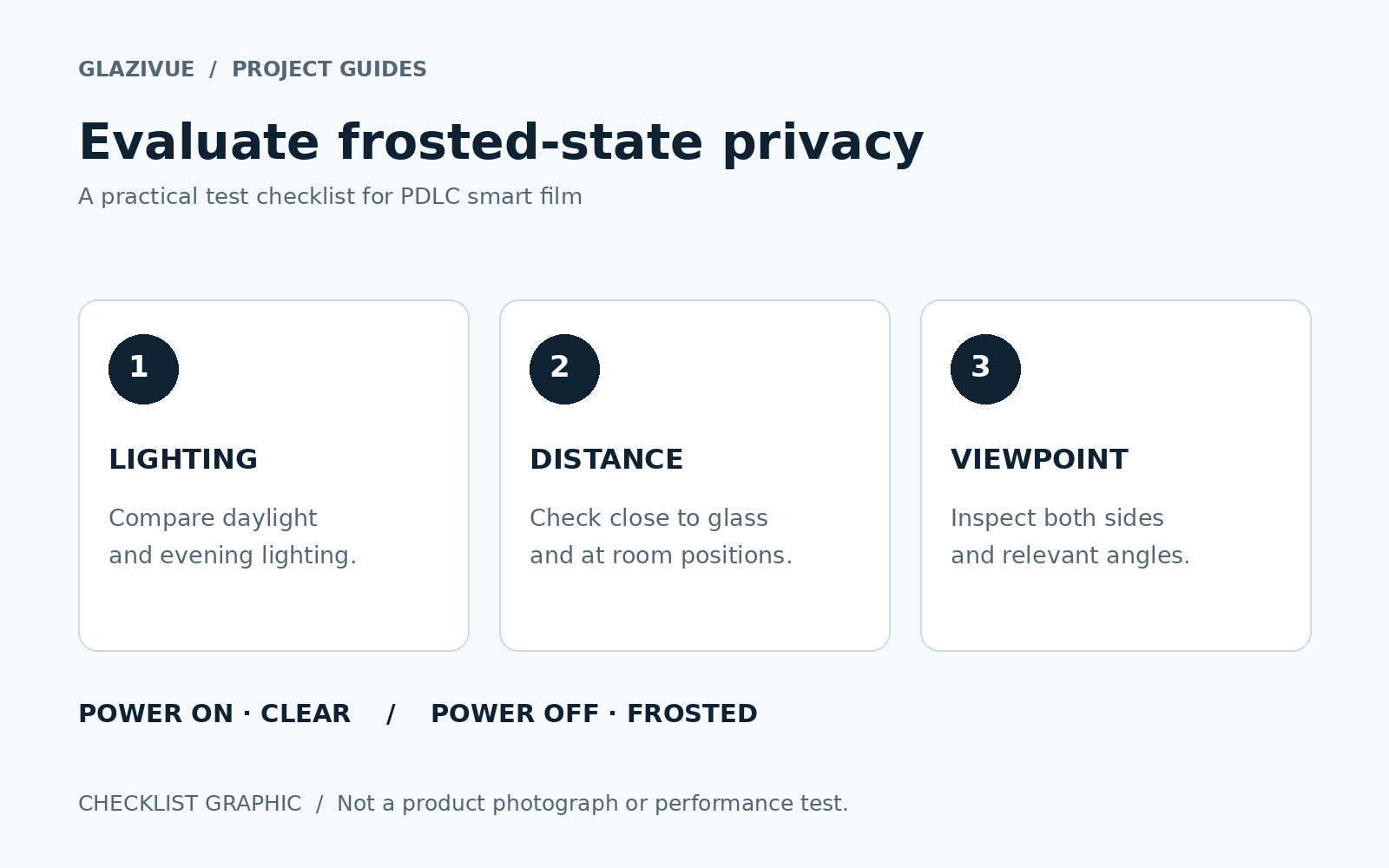
Smart film privacy should be assessed in the room where it will be used. In the frosted state, conventional PDLC film scatters transmitted light and obscures detailed views through glass. It should not be treated as a blackout covering or a guarantee that every shadow and silhouette will disappear under all conditions.
For the conventional PDLC products described by GlaziVue, the operating direction is POWER ON · CLEAR / POWER OFF · FROSTED. The practical question is whether the frosted appearance meets your privacy requirement at the relevant distances, lighting conditions and viewpoints.
Frosted privacy and blackout are different requirements
A meeting room may need to obscure detailed views while maintaining a bright interior. A presentation space may instead need substantial light reduction. Write down which outcome you need before selecting a product.
Frosted PDLC allows light to pass in a scattered form. Switching it off changes visibility through the panel; it does not automatically make the room dark. If blackout is a requirement, discuss a separately specified solution rather than assuming that a frosted appearance will provide it.
Check for outlines as well as fine detail
There are several levels of privacy to consider. You may want to prevent recognition of faces, stop someone reading a display, obscure movement in a room, or avoid visible body outlines. These are different acceptance criteria.
Depending on the film and viewing conditions, a person or object close to a frosted panel may still create a visible outline. A brightly illuminated subject viewed from a darker area can also produce noticeable contrast. Do not use a single photograph as proof that every room arrangement will behave the same way.
Describe the actual requirement to the supplier. For example: “Observers in the corridor should not be able to read the meeting-room display from our normal viewing positions.” That is more useful than asking for “100% privacy” without defining what must be hidden.
Use a simple privacy evaluation checklist
The checklist below is a planning aid, not a laboratory test or a product performance specification.
| Condition | What to compare | What to record |
|---|---|---|
| Lighting | Daylight, evening lighting, brighter room versus darker corridor | Whether outlines or relevant details remain visible |
| Subject distance | Close to the glass and at the intended desk or seating position | Distance and the detail you are evaluating |
| Observer position | Both sides, normal standing positions and relevant angles | The viewpoint where privacy is weakest |
| Power state | Powered clear and unpowered frosted | Confirm state labels before comparing results |
| Coverage | Panel edges, gaps, uncovered areas and doors | Any sightline outside the intended film area |
Test the conditions that matter to your office
Evaluate the sample using the appropriate supplier-specified components and instructions. Ask qualified professionals to handle electrical work. Compare it with a plain-glass reference where practical, and keep the subject and observer positions consistent when comparing different film options.
Inspect both normal use and the most demanding relevant condition, such as a well-lit meeting room beside a dim corridor. Record the setup so another person can repeat the comparison. There is no universal distance that guarantees an acceptable result for every product and application.
For photographs or video, keep framing, exposure and lighting as consistent as possible. Automatic camera adjustments may make two conditions look more different than they appear to the eye. Record visual observations as well as images.
A small sample is a screening tool
A small sample helps compare appearance, but it cannot reproduce a full partition, every viewing angle or the final installation. It also cannot establish long-term performance, electrical suitability or compliance for the complete project.
For a demanding privacy requirement, discuss a representative mock-up and written acceptance conditions with the supplier and your local project team. See how to evaluate a PDLC smart film sample for the broader sample review process.
Include the full glass layout in the privacy plan
Film only affects the area it covers. Clear borders, door gaps, uncovered panes and sightlines around the partition can affect the room’s privacy even when the treated panel performs as expected. Decide whether full or partial coverage suits the intended use.
For an existing office partition, start with the existing office glass planning guide. Provide labeled photos and panel dimensions when requesting a quote. Review product formats alongside the required optical appearance.
Match privacy testing to the chosen treatment
If the glass can remain permanently frosted, compare fixed frosted film with switchable smart film before specifying electrical controls. For a meeting-room doorway, evaluate both the treated glass and surrounding gaps in the closed position. Our office glass door guide helps record the coverage and hardware details.
Frequently asked questions
Does frosted smart film block all light?
No. Conventional frosted PDLC scatters transmitted light. If you need blackout or a specified level of light reduction, discuss that as a separate requirement.
Can someone see a silhouette through frosted film?
A silhouette may be visible under some conditions, particularly where distance and lighting create strong contrast. Evaluate the selected sample in conditions representative of your room.
Does a haze percentage tell me how private the room will be?
Haze is an optical measurement, not a complete privacy rating for your room. Confirm which operating state and test method a figure describes, then assess the actual visibility requirement with a sample or representative mock-up.
Will film prevent people hearing a meeting?
Visual privacy and acoustic privacy are separate issues. Do not infer an acoustic rating from the film’s frosted appearance; discuss sound isolation with your glazing or acoustic professional.
Define the requirement before ordering
Send the room use, privacy concern, lighting conditions and glass layout through Submit a Project, or explore the Sample Kit to start evaluating appearance.
GlaziVue supplies products and assists with selection and quotations. The customer arranges qualified local professionals for site measurement, installation and electrical work.