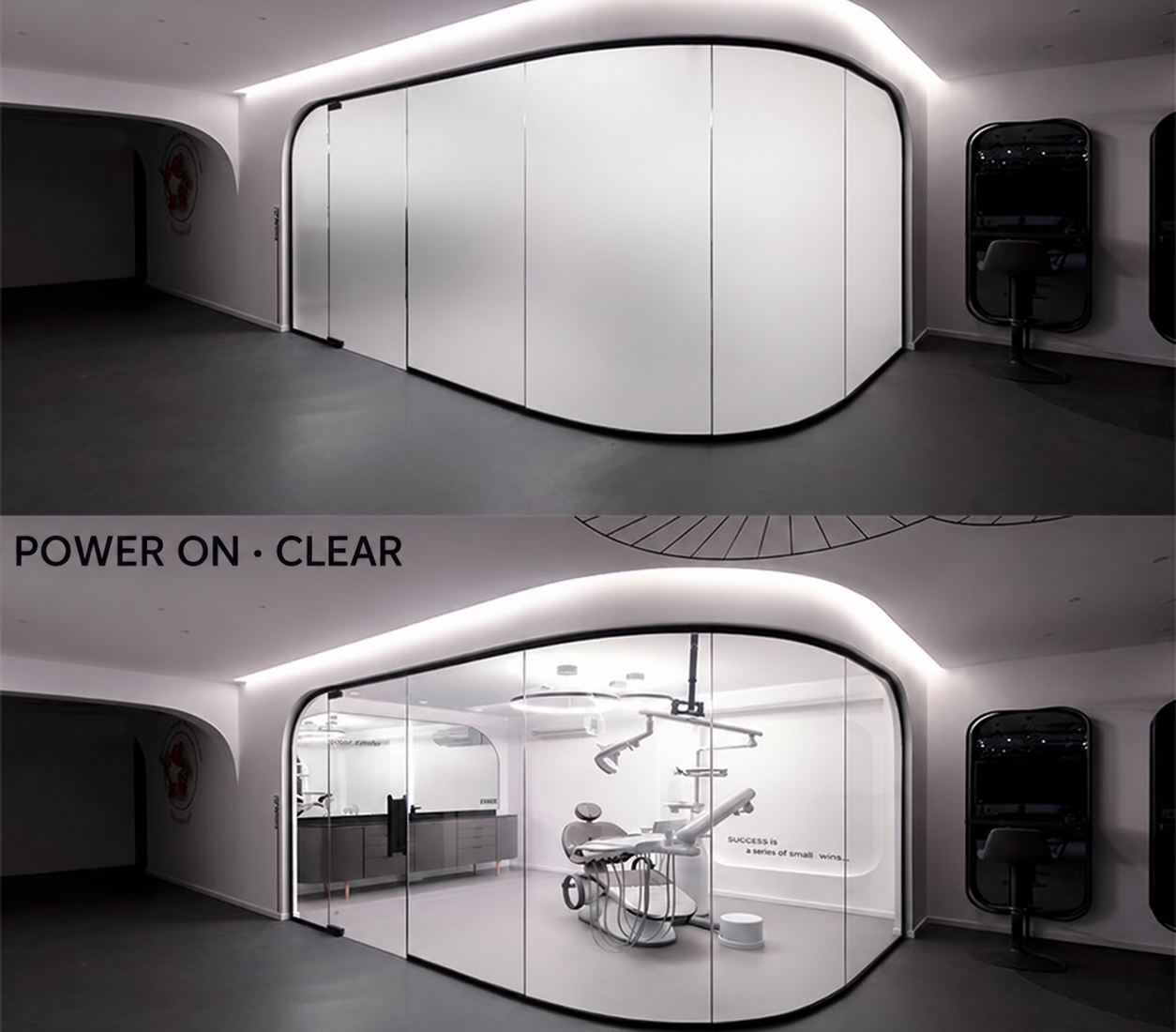
A PDLC smart film sample helps you assess the appearance of switchable privacy before selecting a product for office glass or a meeting room. The useful question is not only whether it switches, but whether the result suits the way people will use and view the space.
For the GlaziVue configuration described here, the operating states are POWER ON · CLEAR / POWER OFF · FROSTED. Confirm the exact model, film format and matched electrical components when arranging your sample.
Use the following evaluation process to make your comparison more informative.
1. Identify exactly what you are testing
Before the demonstration, record the model name and whether the sample is self-adhesive film, lamination-ready film or a finished glass assembly.
Also confirm:
- The sample dimensions.
- Whether the film is mounted on glass.
- The glass construction, if applicable.
- The supplied power and control components.
- Whether the sample represents the specification proposed for your project.
A loose film sample and a finished glass sample answer different questions. For a retrofit project, ask how the sample relates to your existing glass. For new glazing, involve the glass fabricator in the review.
2. Keep comparison conditions consistent
Place candidate samples against the same background, with the same lighting, viewing angle and distance. Compare the same format where possible.
Use a plain background first, then try a room view or a printed reference behind the sample. Avoid choosing a model from separate photographs taken in different environments.
If you record the demonstration, keep the camera position and exposure consistent. Photos and video are useful records, but they should support your direct observation rather than replace it.
3. Review the powered clear state
Switch the sample to its clear state using the supplied or confirmed matched demonstration equipment.
Observe it straight on and at the angles that matter in your room. For example, a corridor beside a glass meeting room creates a different viewing situation from sitting directly opposite the partition.
Look for:
- Whether the view through the sample meets your expectations.
- Visible haze or reflections under the test lighting.
- Appearance against both light and dark backgrounds.
- Any obvious difference between the samples being compared.
“Clear” should not be treated as a promise that every finished assembly will look identical to untreated glass. Ask for the relevant optical test data and understand which model, format and test conditions it describes.
4. Review the unpowered frosted state
Switch the sample off and assess the frosted appearance. Standard PDLC privacy film scatters transmitted light; visual privacy and blackout are different requirements.
For a practical comparison, place an object or a person behind the sample at several distances, then change the background lighting. Check whether details or outlines remain visible in the situations that matter to your project.
A small sample has limited coverage. For a room that needs a specific level of visual privacy, ask your project team whether a larger mock-up is appropriate before approving the full order.
PDLC film controls visibility through glass. It does not establish acoustic privacy for the room.
5. Test in representative lighting
Repeat the comparison near a window and under the type of artificial lighting planned for the space. Where possible, include a condition with brighter light behind the sample.
For a meeting room, consider what someone would see from the corridor during a presentation or an evening meeting. Record the conditions that produce an acceptable result, along with any conditions that need further investigation.
Do not assume that a short demonstration in a showroom represents every site condition.
6. Check switching with the intended demonstration setup
Observe several on/off changes and note any inconsistent behavior. If dimming or another control feature is being considered, confirm that it is supported by the proposed project system, rather than assuming a demonstration accessory guarantees it.
Use only the supplied or confirmed matched power and control components. Do not connect film directly to mains power or improvise electrical connections.
Final wiring and commissioning should be handled by qualified local professionals according to the approved product instructions.
A simple sample evaluation checklist
| Check | What to record |
|---|---|
| Sample identity | Model, format, dimensions and glass construction |
| Powered clear appearance | Straight-on and angled observations |
| Unpowered frosted appearance | Privacy result at relevant distances |
| Lighting | Daylight, artificial light and bright backgrounds |
| Controls | Included components and demonstrated functions |
| Project match | How the sample relates to the proposed order |
| Follow-up questions | Items requiring datasheets or a larger mock-up |
Use the same checklist for every candidate. Keep notes from the people who will approve and use the installation.
What a sample cannot approve
A sample is useful for comparing appearance and demonstrating the supplied setup. It does not confirm final panel dimensions, installation quality, full-system electrical capacity, long-term performance or compliance of your completed project.
Before placing a production order, separately confirm glass suitability, the panel schedule, cable exits, control zones, installation instructions and the written commercial terms.
For existing office glazing, see PDLC smart film for existing office glass.
Connect the sample result to your office layout
Record which sample and viewing conditions meet your requirement, then link that result to a labeled glass panel schedule. Identify moving doors using the office door planning checklist. A sample can help select an appearance; the final layout, coverage and electrical plan still need project review.
Frequently asked questions
Does a frosted sample mean the room will become dark?
No. Standard PDLC privacy film can continue to transmit diffuse light in its frosted state. Discuss blackout separately if blocking light is a project requirement.
Can I choose a model using a video alone?
A video is a useful introduction. Direct sample comparison under consistent conditions provides a better basis for judging appearance, with project details reviewed separately.
Will a small sample look exactly like a full partition?
It cannot guarantee that result. Finished appearance depends on the film, glass construction, lighting, viewing conditions and installation. A larger mock-up may be useful for demanding visual requirements.
Discuss samples for your project
Review the GlaziVue Smart Film Sample Kit and confirm the current contents, available configuration and delivered quotation before payment.
When you are ready to discuss the installation, submit your project details with your location, glass photos and approximate panel dimensions. Your qualified local team handles measurement, installation and electrical work.