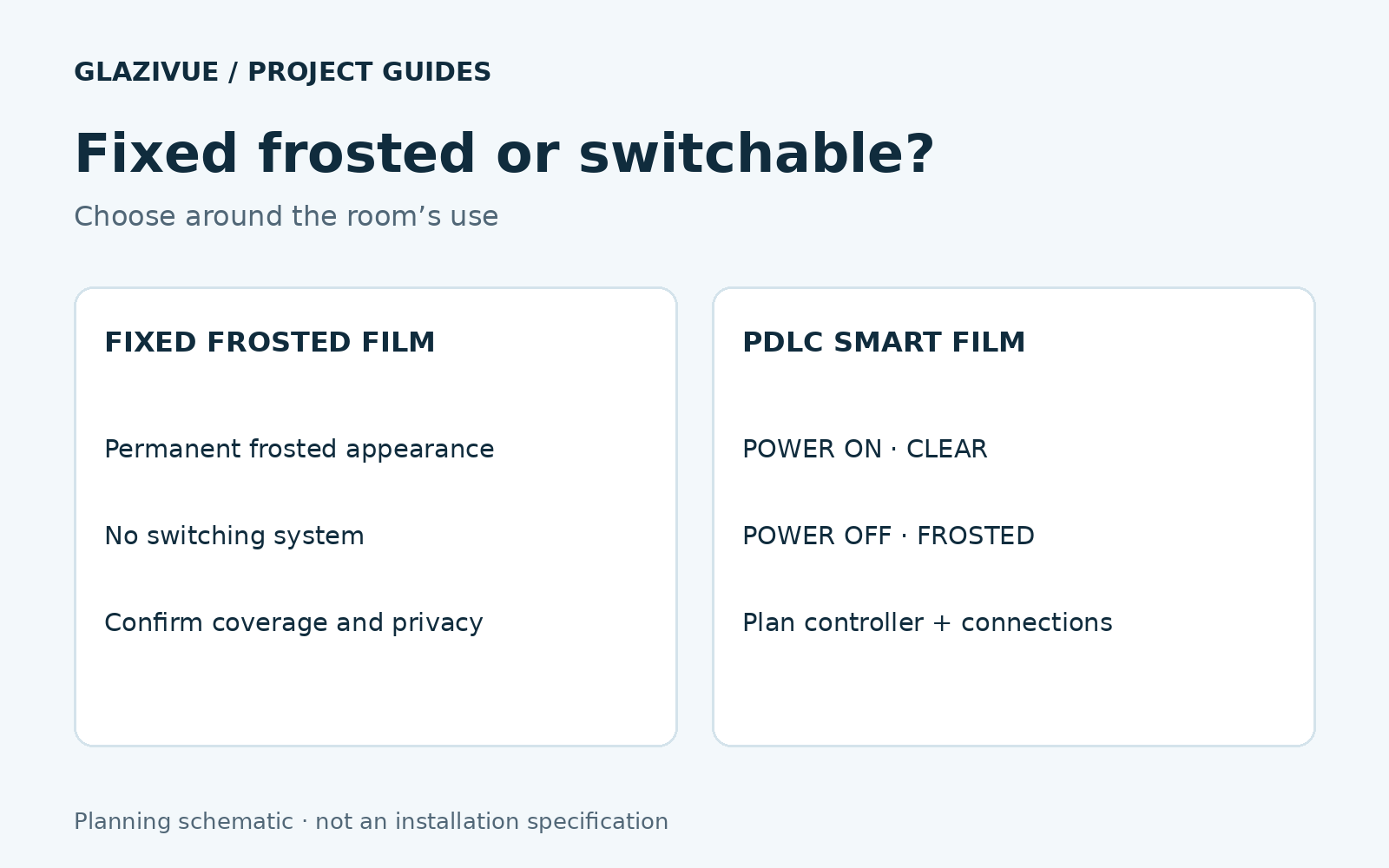
When comparing smart film vs. frosted window film, start with one question: should the glass stay frosted all the time, or should users be able to switch between a clear view and a frosted appearance? Fixed frosted film provides a permanent visual treatment. Conventional PDLC smart film changes state using a compatible electrical system.
For the PDLC products described by GlaziVue, the operating direction is POWER ON · CLEAR / POWER OFF · FROSTED. The right choice depends on the room’s use, desired appearance and practical installation route.
What each film changes
Fixed frosted window film is applied to glass to create an etched or frosted effect. Once installed, its appearance does not change with a switch. You can specify full coverage, a privacy band or another pattern, subject to the chosen film and installation details.
PDLC smart film adds an electrically switchable layer. In the unpowered state, it scatters transmitted light and creates a frosted appearance. When powered by the appropriate system, it changes to a clear state. Evaluate both appearances with a sample: “clear” does not mean that the treated glass will be visually identical to untreated glass.
A practical office comparison
| Decision | Fixed frosted film | PDLC smart film |
|---|---|---|
| Daily appearance | Remains frosted where applied | Switches between clear and frosted |
| Electrical planning | No electrical system needed for the frosted effect | Compatible controller, connections and power required |
| Room use | Useful when a consistent frosted treatment is wanted | Useful when open views and visual privacy are needed at different times |
| Coverage design | Full coverage or a specified fixed pattern | Coverage, connection position and switching groups require planning |
| Light reduction | Depends on the selected film | Frosted PDLC should not be assumed to provide blackout |
When a fixed frosted treatment makes sense
Consider fixed film if a room needs the same visual treatment throughout the working day. For example, a workspace may need a permanent privacy band while retaining an open view above it. There is no need to plan a switching system if no one needs the covered area to become clear.
Ask for a sample of the exact material and pattern. Compare the view from both sides, particularly where a bright room adjoins a darker corridor. Privacy depends on coverage and viewing conditions, so avoid choosing from a decorative photograph alone.
When switching adds useful flexibility
A meeting room may be open to the office when unused, then need visual separation during a meeting. A switchable treatment lets the same covered area serve those two uses without a moving blind. That flexibility is the main reason to consider PDLC rather than judging the products only by their frosted appearance.
Specify who will control the film, which panels should switch together and where the control will be located. Confirm the available control options for the selected model before promising app control or building-system integration.
Compare the complete project scope
Request quotes on the same basis: identical panel references, dimensions, quantities and coverage boundaries. For PDLC, ask what is included for the film, controller and connections. Identify local installation and electrical work separately so a material-only quote is not mistaken for a complete installed price.
Existing glass, frames, doors and cable routes can affect the practical choice. Review the office smart film quotation guide and provide a panel-by-panel glass schedule. Do not assume one film format is suitable for every glazing assembly.
Check privacy and appearance before deciding
Neither a frosted label nor a single haze figure defines the privacy of an entire room. Test the detail that matters: can a corridor observer recognize a person or read a display from the intended position? Record the lighting, subject distance and viewpoint. Our frosted-state privacy guide explains how to frame that assessment.
Compare maintenance instructions as well. A surface-applied film and a laminated glass assembly may require different handling. Confirm approved cleaning materials and edge-care requirements for the exact product instead of applying a generic window-cleaning routine.
Check whether the existing partition can stay
For an existing partition, review the PDLC office glass retrofit guide before selecting a surface-applied product. If glazing is being replaced, compare smart film and laminated switchable glass with your project team. Flag moving doors separately using the glass door planning checklist.
Frequently asked questions
Can ordinary frosted film become clear with a switch?
No. A fixed frosted treatment remains fixed. If switching is required, specify an electrically switchable product and its compatible components.
Is smart film automatically a blackout solution?
No. Conventional frosted PDLC scatters transmitted light. Discuss blackout as a separate requirement and assess a specifically suitable solution.
Can both options be applied to existing office glass?
Surface-applied versions can be considered for existing glazing, but suitability must be checked for the selected material, glass condition and intended environment.
Choose around the room’s actual use
Write down whether the covered area needs to become clear, what privacy must achieve and who will operate it. Review GlaziVue product formats, then submit your project with photos and panel dimensions. GlaziVue assists with product selection and quotations; qualified local professionals handle site measurement, installation and electrical work.