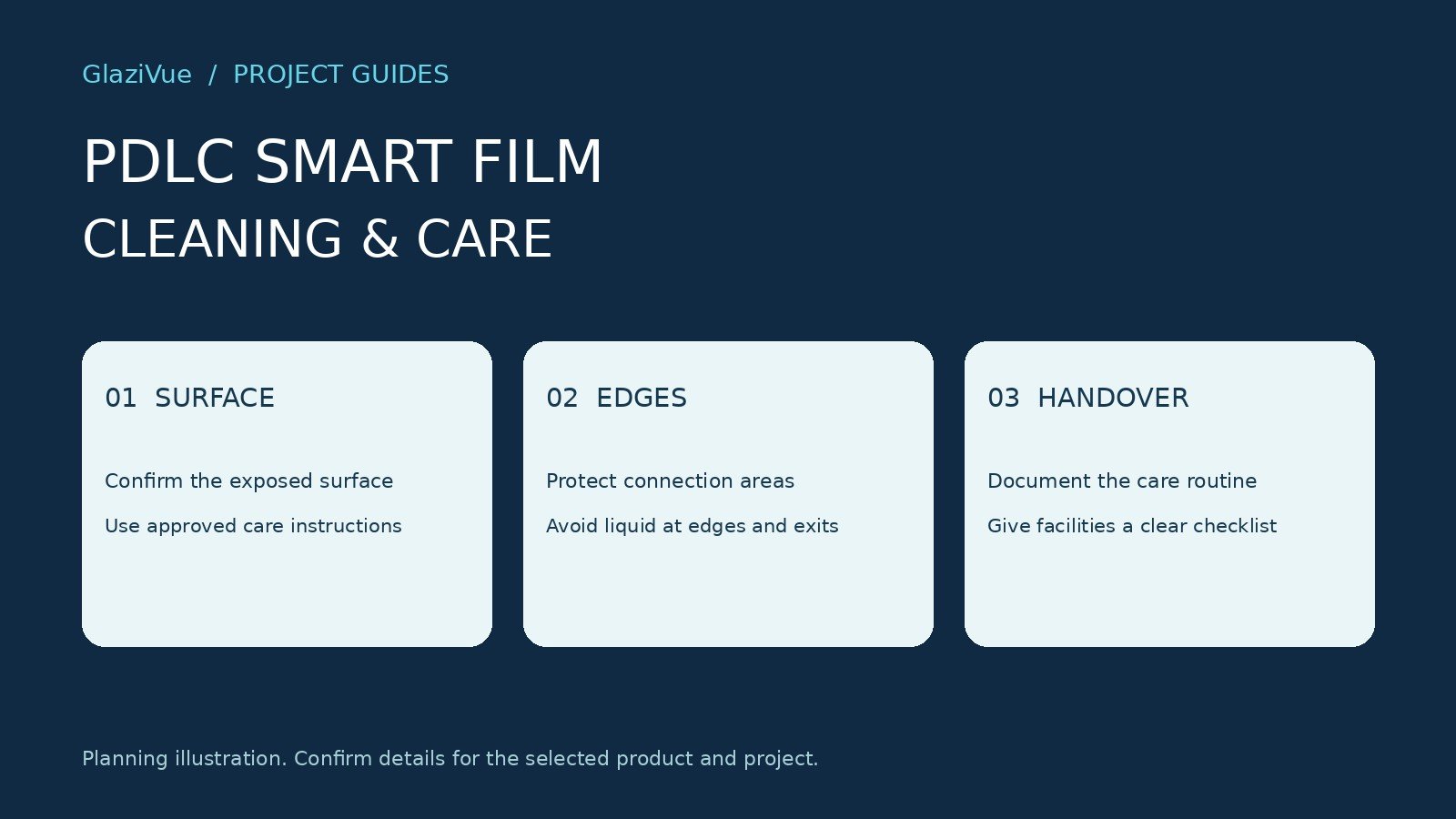
PDLC smart film cleaning starts with identifying the surface that your facilities team will actually touch. A retrofit film applied to existing office glass and a PDLC layer protected inside a glazing assembly need different care instructions. Before handing over a meeting room or partition, agree on the approved method for the selected product and record it where the cleaning team can find it.
This guide is a planning checklist for office managers, designers and procurement teams. It does not replace the care sheet supplied for your particular GlaziVue product and installation. For GlaziVue PDLC products, the switching states are POWER ON · CLEAR / POWER OFF · FROSTED. Cleaning procedures and electrical isolation are separate matters: any work near connections should follow the project’s approved safety instructions.
Identify the exposed surface before choosing a cleaner
Check whether the room-facing surface is exposed applied film, ordinary glass, or a protective surface specified for the system. Do not assume that a bottle labelled “glass cleaner” is suitable for every surface on a switchable partition. Record the product model, surface orientation and the relevant care document in the room handover file.
If you are comparing retrofit film with a new glazing assembly, review our smart film versus switchable glass guide. The decision affects more than installation: it also changes which surfaces the cleaning contractor will maintain.
Build an approved cleaning routine
Ask for written confirmation of the permitted cloth, cleaning agent, application method and any drying requirements. Do not establish a universal rule that alcohol, ammonia, solvent cleaners or disinfectants are safe for all PDLC films. Compatibility needs to be checked against the supplied product instructions, including any protective layers and edge treatment.
Where the approved instructions allow wiping, use the specified clean, soft cloth and method. Check that it has not picked up grit from another surface. Keep abrasive pads, blades and scraping tools out of the routine unless the product instructions expressly permit them. Construction residue, paint or adhesive contamination should be assessed before anyone tries to remove it aggressively.
A useful facilities procedure names the approved supplies rather than simply saying “clean as normal.” It also explains what staff should do when an unfamiliar stain appears. Put a contact and escalation route on the checklist so the team can pause instead of experimenting on an installed panel.
Protect edges and electrical connection areas
Treat film edges, seams, busbars and cable exits as distinct from the central surface. The cleaning plan should prevent liquid from being directed into these areas. Avoid an unapproved routine that sprays the entire partition or leaves liquid collecting around trim, door hardware or cable penetrations.
Inspect visible edge protection during handover and record any areas requiring assessment by the installer. A cleaner should not remove trim, lift an edge, open an electrical enclosure or reapply a sealant as part of routine care. The approved assembly details and compatible materials should be confirmed by the project team.
Separate routine care from fault investigation
Agree on a simple reporting process for new marks, edge lifting, unusual appearance or a change in switching behaviour. Record the panel identifier, location, date and photographs. Describe whether the observation occurs in the clear state, frosted state or both; do not diagnose an electrical fault from appearance alone.
If connections or controls need inspection, refer the issue to the responsible qualified professional. Do not ask janitorial staff to open power supplies or alter wiring. Our power supply and controller checklist helps teams document the control arrangement before handover.
What to include in the facilities handover
Give the facilities team the selected model and supplier reference; a drawing with panel IDs; the approved cleaning and care sheet; the named cloth and cleaning supplies; the location of protected edges and connections; and the contacts responsible for installation and electrical work. Include a short log for changes or damage, so observations remain tied to the correct panel.
Review the procedure with the actual cleaning contractor before the room enters regular use. A sample can support that discussion, but a sample test is not permission to use an unapproved chemical on the final installation. See our PDLC sample evaluation guide for the broader review process.
PDLC smart film cleaning: a daily care checklist
Use this checklist alongside the approved care sheet for the selected product. If the surface or cleaning method is not confirmed, obtain that information before cleaning.
| Check | Routine action | When to pause and report |
|---|---|---|
| Surface and instructions | Confirm the panel ID, exposed surface and current approved care sheet. | The surface is unknown or the care sheet is missing. |
| Cloth and cleaning agent | Use only the cloth, agent and method named in the product instructions; check the cloth for grit. | A new cleaner, disinfectant or abrasive tool is proposed. |
| Edges and connections | Follow the approved method without directing liquid into seams, film edges or cable exits. | Liquid has collected near a connection, or edge protection appears damaged. |
| Marks and contamination | Record the panel ID and photograph an unfamiliar mark before attempting removal. | Paint, adhesive or construction residue would require scraping or an unapproved chemical. |
| Appearance and switching | Note any new mark, edge lifting or change in appearance, including the observed switching state. | A panel changes behaviour or needs electrical inspection; refer it to the responsible qualified professional. |
Keep a simple care log: panel ID, date, observation, photo reference and person notified. Do not treat this checklist as approval for a particular cleaner or repair method.
Frequently asked questions
Can I clean PDLC smart film like ordinary office glass?
First identify the exposed surface and obtain the instructions for the selected product. An applied film surface should not automatically inherit the routine used for ordinary glass elsewhere in the building.
Which cleaner is safe for GlaziVue smart film?
Request the approved care guidance for your selected model and assembly. This article does not declare a particular chemical or household cleaner compatible with every GlaziVue product.
Can the cleaning team repair a lifted edge?
Routine cleaning should not include lifting film, resealing edges or changing electrical connections. Document the issue and refer it to the responsible installer or qualified professional.
Plan care before ordering
When you submit your project, include the room use, proposed product format, cleaning routine and any planned disinfectants. Ask which care instructions apply to the selected GlaziVue product. GlaziVue supplies products and project information; local qualified trades are responsible for site measurement, installation and electrical work. Email projects@glazivue.com to discuss your project requirements.
Discuss your office glass project
Send your project location, approximate glass area, photographs and product format. For care questions, include the selected model and the proposed cleaning supplies so the applicable product guidance can be confirmed.