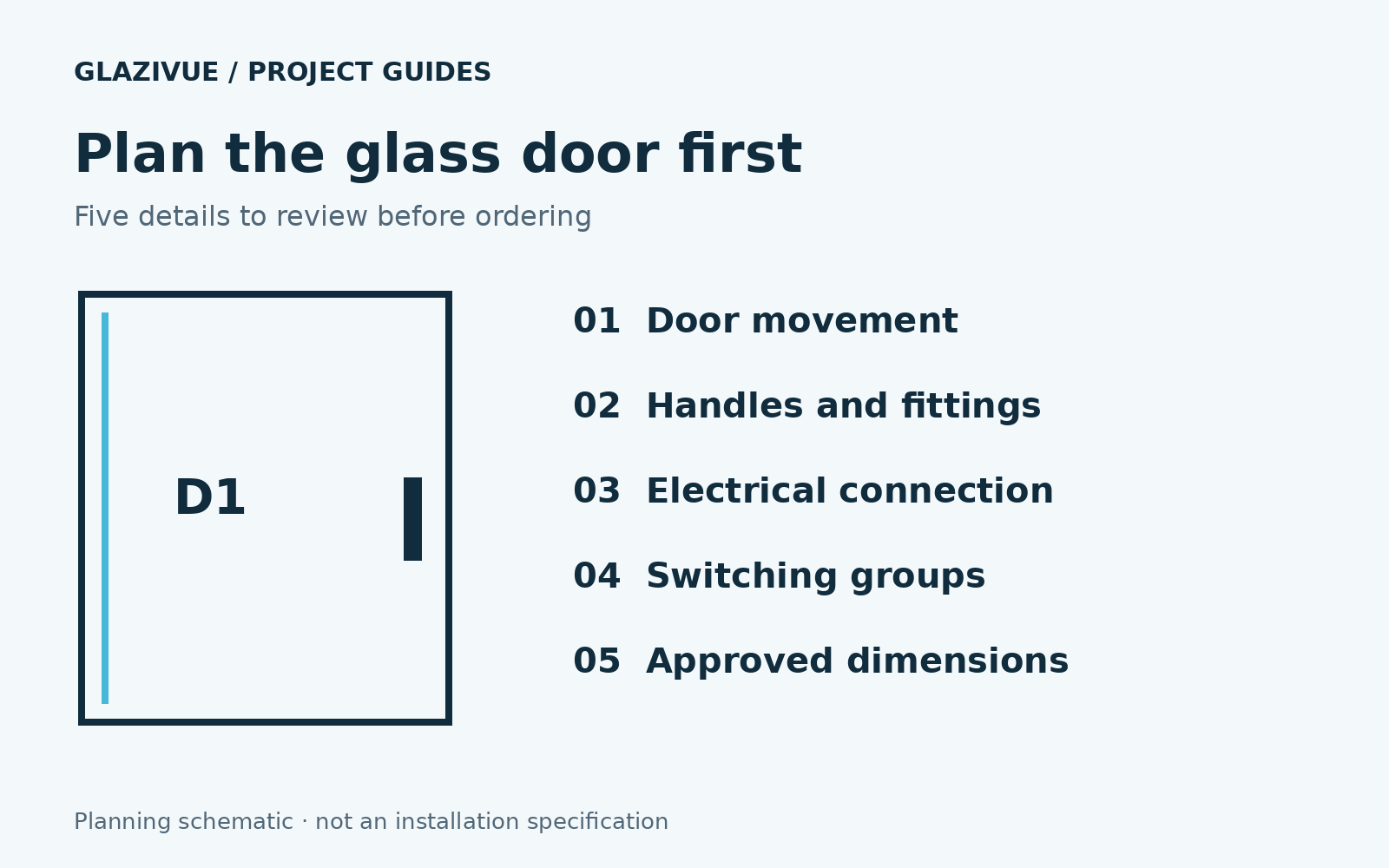
Smart film for office glass doors needs more planning than film on an adjacent fixed panel. The door moves, hardware interrupts the glass surface, and the electrical connection must accommodate normal operation. Before ordering, confirm the door type, coverage, connection route, switching groups and final production drawing.
Conventional GlaziVue PDLC operates as POWER ON · CLEAR / POWER OFF · FROSTED. This guide is a project briefing checklist, not a wiring or installation specification. Your local glazing professional and electrician should review the door and electrical arrangement with the supplier.
1. Identify how the door moves
Record whether the door is hinged, pivoting, sliding or part of a folding partition. Provide an overall photo and close-ups of the top, bottom and hardware. For sliding or folding systems, show the tracks and the panels in their usual open and closed positions.
A connection detail designed for fixed glass should not be assumed suitable for a moving door. Ask the project team how power will reach the film throughout the required movement, and whether the chosen connection components are compatible with the door hardware and film system.
Flag concealed frames or restricted spaces early. If the available route has not been inspected, mark it as an open design item rather than approving a solution from a photo. GlaziVue does not claim that a particular electrical hinge or door-transfer accessory is included unless it is explicitly confirmed in the quotation.
2. Define coverage around handles and fittings
Photograph handles, locks, hinges, pivots, clamps and seals. Label the door separately from fixed panels, even if the dimensions look similar. State whether you want full visible-glass coverage or a partial privacy area.
Any holes, notches or unusual boundaries need a reviewed drawing. Do not assume the delivered film can be cut around hardware on site. Confirm permitted processing and handling for the selected format before manufacture. Required edge clearances and connection positions must come from the supplier’s project instructions.
Check the intended viewing line through uncovered areas. A clear border, gap or adjacent untreated pane may affect visual privacy even when the covered area is frosted. Discuss the complete doorway rather than assessing only the middle of the film.
3. Review the electrical route before production
Identify the proposed controller location, connection side and route to the moving panel. Have the local electrician confirm the suitability of the supplier-specified equipment for the site. Do not connect film directly to building mains or substitute a generic power supply without supplier approval.
The local team should review the connection through the door’s normal range of travel, including any potential pinch points or conflict with seals and fittings. Confirm responsibility for installation, inspection and later servicing. A product quotation does not by itself establish a safe or complete door wiring design.
4. Decide which panels switch together
A meeting-room door may need to switch with the surrounding partition, or it may need separate control. Label each intended group on the panel schedule and explain the normal room use. Confirm controller selection and capacity with the supplier for that layout.
Describe what occupants expect when electrical power is unavailable. Conventional PDLC becomes frosted when unpowered. This optical behavior does not change the door’s mechanical function, establish an access-control system or replace the project’s door safety requirements.
Assess visual privacy in the closed position using relevant room lighting. Review our frosted-state privacy checklist and sample evaluation guide before approving the optical appearance.
5. Approve a drawing that matches the actual door
Before releasing the order, confirm the panel reference, final film dimensions, orientation, coverage boundary, connection side and any agreed hardware details. Use one clearly identified drawing revision. Preliminary quote measurements and final production dimensions should not be treated as interchangeable.
| Item | Information to provide |
|---|---|
| Door reference | A unique label matching the photos and panel schedule |
| Movement | Hinged, pivoting, sliding or folding, with relevant hardware photos |
| Glass and coverage | Dimensions, measurement basis and intended treated area |
| Connection | Proposed side and route, marked confirmed or still under review |
| Switching | Door-only control or a group with neighboring panels |
| Project team | Who handles measurement, installation and electrical work locally |
Use our glass measurement guide to prepare the quotation schedule. Include estimates only when they are clearly labeled, and obtain final measurements before approving production.
Coordinate the door with the surrounding office partition
If the existing glass will remain, start with the office glass retrofit guide. If a new glazing package is planned, compare smart film and switchable glass before the frame and electrical exits are fixed. Mark the door and adjacent panels on the same schedule so coverage and control groups can be reviewed together.
Frequently asked questions
Can smart film be considered for a sliding glass door?
Yes, but the movement and electrical connection need a project-specific review. Do not assume a connection arrangement for a hinged or fixed panel suits a sliding system.
Can the door and surrounding partition switch together?
That can be a design objective. Confirm the panel grouping and compatible controller arrangement with the supplier before ordering.
Does smart film replace the door’s safety glazing requirements?
No. Treat the film as an optical product. The local project team must confirm the glazing, door hardware and applicable project requirements separately.
Prepare a door enquiry with useful detail
Send labeled door photos, dimensions, movement type and your proposed switching groups through Submit a Project. Explore product formats for existing-glass and new-glazing routes. GlaziVue supplies products and assists with selection and quotations; customers arrange qualified local professionals for site measurement, installation and electrical work.